
Describing banknotes
How do we describe banknotes?
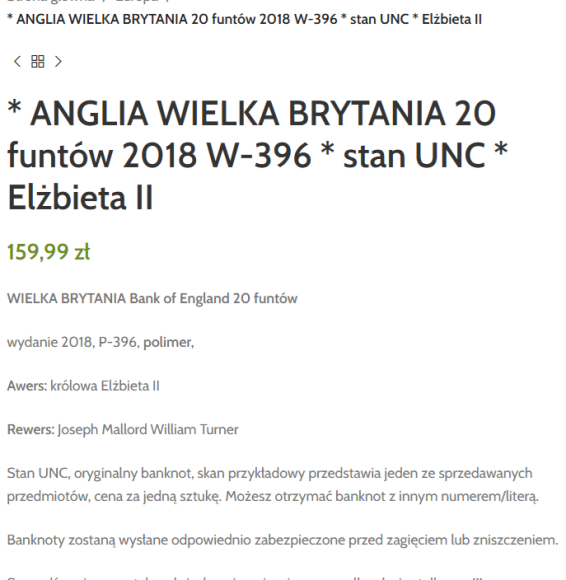
Listing title: country name, denomination, currency, year of issue, catalog number, condition grade, and sometimes additional information, e.g., that it is a new issue, a specific series, or the main motif featured on the banknote.
Other information in the listing description:
> Price
> Country, sometimes the issuing bank, denomination, and currency name
> Year of issue - sometimes the issuer did not include the year of issue, in which case it is marked as ND (No Date) or with a date range covering the years during which the banknote was issued
> P- or W- Catalog number
> Banknote material
> Brief description of the obverse - the front, main side, and the reverse - the back side of the banknote.
> Condition grading.
> Other information.

Detailed explanations:
> The issuer may be the name of the country, territory, or bank that issued the banknote.
> ND - No Date - meaning an undated banknote; in such cases, if possible, an estimated year of issue or the date range during which the banknote was in circulation is provided
> The catalog number is based on the Pick catalog, hence the designation P- followed by the catalog number. This numbering system is based on the Standard Catalog of World Paper Money, originally created by Albert Pick. Banknotes were cataloged this way until around 2020. Currently, the catalog is no longer published, but continuations are maintained by platforms such as Bank Note Museum, in which case the designation W is used.
> Traditional banknotes were produced on paper, but polymer (a plastic material) is increasingly being used, as it is more durable and allows for superior security features as well as better visual effects. Hybrid banknotes, which combine paper and polymer, are also appearing.
> The obverse, or the front side of the banknote, usually features the name of the issuer (the central bank), national symbols, or a portrait of a prominent figure, as well as the denomination and currency in the native language of the country.
> The reverse, or the back side of the banknote, contains additional information and elements that complement the artwork shown on the obverse.
> Condition grading - learn more
> Other information - additional details on whether it is a set or if the price is for a single piece in a multi-item listing. Often, the photo in the listing is for illustrative purposes, and the series or serial number of the banknote you receive will be different, unless the listing description explicitly states that a specific series or number is being sold.

How do we grade banknote conditions?
Condition grades - based on IBNS (International Bank Note Society) standards, indicated by letter codes along with their numerical equivalents, which may also sometimes include a plus or minus symbol:
UNC - Uncirculated (grade 1, crisp uncirculated) - a perfectly preserved item with no visible signs of circulation. The paper must be clean, crisp, firm, with vibrant colors and sharp corners.
aUNC - About Uncirculated (grade -1, near uncirculated) - visually an outstanding banknote, but with minimal signs of handling/circulation. It may have minor counting folds, a vertical count mark from a counting/sorting machine, or a light center bend (not a hard fold). However, it cannot have two of these flaws at the same time. The paper should be clean and the corners sharp, unless the sole flaw is dull corners or a single creased corner.
XF or EF - Extremely Fine (grade 2, extremely fine/choice condition) - a very attractive banknote showing minor signs of circulation. It may have up to three light folds or one sharp crease. The paper is clean and crisp, with vibrant colors and sharp corners.
VF - Very Fine (grade 3, very fine condition) - an attractive item, but showing more noticeable signs of circulation. It may have several vertical and horizontal folds. The paper may be slightly soiled, but remains firm, though no longer crisp. Margins and corners may show clear handling wear, but without tears or fully rounded corners.
F - Fine (grade 4, fine condition) - a heavily circulated banknote with numerous creases, folds, and paper wrinkling. The paper is soiled and may feel somewhat limp/soft. Small tears along the margins may be present, but they must not extend into the design. Central wear should not result in a hole or tear. Colors remain clear. Staple holes are acceptable.
VG - Very Good (grade 5, very good condition) - a heavily worn banknote, but still completely intact. Corners may be worn and rounded; minor tears or cuts may be present and can extend into the main design area. A center pinhole or hole from repeated folding is possible. Soiling and stains are acceptable, colors may be faded, and the paper soft, but no piece of paper may be missing.
G - Good (grade 6, good condition) - a heavily worn banknote with defects and missing pieces caused by long circulation, such as numerous folds, stains, heavy soiling, graffiti/writing, pinholes, and minor edge chips or small missing pieces.
FAIR - Grade 7 (fair condition) - a severely worn banknote; there may be missing pieces of paper or parts of the design and lettering may be illegible.
POOR - Grade 8 (poor condition) - a severely damaged/worn banknote, torn, with large missing pieces, stains, graffiti, or damage, yet still recognizable as a specific banknote.
Traditionally, banknotes were printed on paper, making them flat and smooth, without major waviness, bulges, or raised elements. Polish banknotes from the PRL (Communist era) period are a prime example. In an era before not only printers but also computers existed, the main security features were intricate ornamental designs and, occasionally, a subtle watermark. Technological advancements and wider access to them forced mints to change their production methods to prevent counterfeiting. As a result, banknotes are no longer completely flat, yet they are still graded as UNC, which sparks controversy among some collectors. However, these are natural characteristics resulting from the manufacturing processes—they are inherent features of new banknotes and therefore do not lower their grade. If a banknote were damaged during the production process, it would be classified as an error (destruct). Otherwise, it is considered a natural characteristic.
Since the 1990s, additional security features have been introduced, such as security threads made of metal or plastic, or holograms. Consequently, distortions appeared around these features during the cutting process. This stems from the differing material structures of the respective components: paper behaves differently during cutting than metal or plastic does. Therefore, when a banknote combines at least two different materials, this usually manifests as a waviness around the security thread—the wider the thread, the greater the distortion. Banknotes from Sweden or Denmark serve as prime examples.
Frequently, a semi-circular indentation—commonly referred to as a "fingernail" mark—appears at the top and/or bottom of the banknote near the security fibers. Banknotes from Venezuela are a prime example.
Another element that does not lower the grade is slight ink transfer (bleeding) along the margin. This often occurs when the ink is black or dark and the margins are white, as seen in US dollar or Japanese banknotes. Banknotes tightly packed together in a brick or strap can naturally transfer ink onto the adjacent note.
Cornerstone – an intentional watermark-like embossing or wave pattern placed in the corners of banknotes, frequently used by the British printing company Thomas De La Rue, which supplies banknotes to many countries in Africa and the Caribbean.
These are completely natural and intentional features found on UNC banknotes. Just as in the 1980s, when a prominent watermark caused a slight bulge in the paper without affecting the note's UNC grade, today's raised areas around security threads or "fingernail" indentations likewise do not impact the grading of the banknote.
